Welcome Back! Family Strategies for a Strong Start to the New School Year!
Parents and caretakers, there’s no better time than the first weeks of school to build a strong foundation for your child’s personal, social, and academic success.
We’re excited to share our Key Steps for a Successful School Year Toolkit, designed especially for the 2026–2027 school year! It features insights and strategies from experienced educators who are part of our Harmony Educator Advisory Group. These leaders have spent decades positively shaping classrooms and healthy learning across the country.
This toolkit isn’t just another back-to-school checklist. We’re offering practical, research-informed guidance to support your children in meaningful ways. Inside, you’ll find tools and tips to help your child:
Build strong, healthy relationships
Develop a sense of belonging at school
Feel seen, heard, and understood
Strengthen their overall wellness and mental health
Sanford Harmony at National University draws from years of research and educator experience to create resources that prioritize what truly matters: relationships, belonging, and well-being. These foundational factors pave the way for lifelong success in school and beyond.
We hope you use our toolkit – available in both English and Spanish – to help your children thrive both in and outside of the classroom.
Special thanks to our educators who contributed their voices and expertise to our toolkit:
Get ready to spark connection and fun for the whole family! This new, innovative app makes it easy for busy families to support skill-building, strengthen connection, and enjoy quick, meaningful interactions every day. Learn More!
By: Miriam Blanc-Gonnet, Sr. Manager of User Strategy at Sanford Harmony
It’s that time of year again: notebooks, binders, and pencil pouches in vibrant colors and designs line the entryway of store aisles across the country. “Back to school” is upon us. Some of you may even already have your first week or two behind you.
As a former educator, I always felt equal parts excited and anxious in the weeks leading up to the first day of school. I could not wait to meet my students, and I planned all sorts of fun “get to know you” activities for us to do together. At the same time, I also couldn’t stop thinking about how that first day might go. Worries like, “Do I still remember how to teach?” or “When that 8 a.m. bell rings, will I still know what to do?” would race through my mind.
As we approach the beginning of another year, I want to remind you of something: your students are both excited and anxious, too — you are in this together. I encourage you to take this first week of school slowly and use it to foster relationships, develop community, put routines into place, and take care of yourself in the process. And if you’re looking for support for creating the best healthy learning environment, Sanford Harmony has resources to help you do just that.
Building a Community
To make the start of your school year a bit smoother, the Harmony Curriculum includes aBuilding Community Pre-Unit to guide you through your first ten days of school. The lessons within this unit offer simple relationship-building routines and activities designed to help both you and your students settle in and connect with each other.
During the first week, you’ll introduce Meet-Up, starting with simple steps like Greeting and Sharing and Responding.
For example, on Day One, your students might use the “25 Ways to Say Hello” resource to greet each other in creative ways. You could also model “Sharing” by telling a short story about how you felt preparing for the first day — then invite students to share and respond in return. As the week progresses, you’ll introduce the additional components of Meet-Up: Checking-In and Connecting.Another key practice introduced early on is Harmony Goals, where students create both class and personal goals. These help build ownership and shared expectations, contributing to a sense of belonging and collaboration in your learning environment. Goal-setting also becomes a powerful tool for reflection and accountability as the year unfolds.
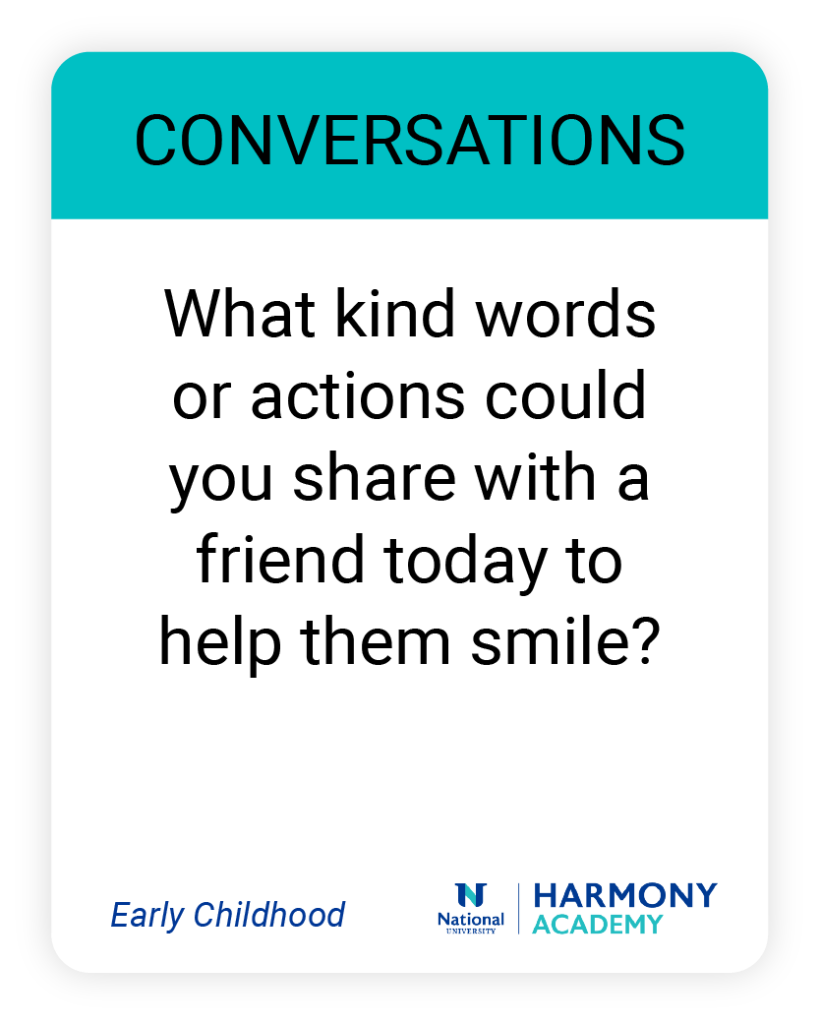
You’ll also introduce Buddy Up, a practice that encourages students to connect and collaborate with peers through age-appropriate prompts. Harmony’s updated Quick Connection Cards— designed for both classroom and out-of-school time — make this easy. Try one on the first day to help new buddy pairs break the ice:
Remember to Prioritize YOU!
In addition to this focus on developing community and establishing a routine, through the first few weeks (and the entire school year, really), you must prioritize filling your cup. 2019 National University Teacher of the Year and Educator Advisory Group member Tom Whisinnand (aka Mr. Whiz), has some great advice on this:
“Starting another school year can be a stressful time. There are many tasks that need to be accomplished and there is limited time to accomplish them. Starting a year by keeping YOUR personal worth in mind is mega-important!”
“Starting another school year can be a stressful time. There are many tasks that need to be accomplished and there is limited time to accomplish them. Starting a year by keeping YOUR personal worth in mind is mega-important! Teachers MUST look after their own well-being Just as we set up routines in our classrooms that empower students to embrace social, emotional, and academic learning, we MUST start the year by embedding these practices in our personal lives.”
Additionally, Mr. Whiz shares his tips for educator self-care during the upcoming school year.
“During this upcoming year, I will be looking after my own well-being in the following ways: 1) I will be visiting a gym on a regular basis; 2) I will create and maintain professional/personal work boundaries; AND 3) I will engage in a creative activity (painting/writing/drawing/producing YouTubes) at least once during any given weekend.”
Mr. Whiz is spot-on. You need to consider how you will maintain your own mental, emotional, and physical health during what is often a chaotic time.
Want a Little Extra?
Everything you need to implement Harmony is available to you at no cost through our Online Learning Portal — including full access to the Building Community unit, Everyday Practices, and digital storybooks.
We also know that many educators appreciate having ready-to-useand printed materials. That’s why we offer a selection of premium resources, designed to make implementation even easier.
Harmony Classroom Kit:
If you prefer having ready-to-use materials on hand, the Harmony Classroom Kit offers printed resources to support your implementation. It includes over 200 Quick Connection Cards for peer conversations, engaging story books for Pre-K–5th, a plush Z doll to help bring lessons to life, and grade-level literature guides developed to integrate relationship skills into literacy instruction. These tools help make Harmony even more accessible in your classroom.
We can’t wait to share our new app with you this fall! You will soon be able to encourage families to support their child’s development of essential skills, promote well-being, and strengthen relationships at home with the Harmony at Home app — designed to make it easy to extend classroom learning into everyday family life through quick, on-the-go activities. Follow us on social media for the launch date!
You’ve Got This!
Starting a new school year is a big deal — for you and your students. Remember to give yourself grace, celebrate the small wins, and prioritize connection over perfection. The learning will come — what matters most right now is helping your students feel like they belong.
We encourage you to get started exploring our Harmony Curriculum in the Harmony Online Learning Portal, and follow us on social media for more exciting updates this fall.
We hope you have an amazing start to the new school year!
Miriam Blanc-Gonnet, Sr. Manager of User Strategy at Sanford Harmony
Originally published on 08/06/2025, updated on 07/17/2026
The fall leading into the holiday season is such a ripe time for gratitude. We are already engaged in celebrating the harvest at Thanksgiving and offering thanks with friends and family. But our lives are full and often rushed and gratitude can become something we may remember to do only on the holiday itself. So how do we ground ourselves in gratitude as a mindset throughout the holiday season and beyond?
This year, my son is a senior in high school. I have no idea how we arrived at this moment so quickly. And precisely because I know it’s the last year with him living at home, I am keenly aware of savoring every moment. There are plenty of milestones through a child and teen’s years that call us to that kind of savoring. Whether it’s the year your baby first walked, or the year when a big family gathering is possible, or the year when your kindergartener is wearing his superhero costume everywhere you go, these may not be possible the following year and are moments to treasure.
Although gratitude can exist as a feeling or mood, we are capable of cultivating more gratitude in our lives by becoming intentional about generating it and staying in its goodness.
Robert Emmons, a gratitude researcher, defines gratitude as “a sense of thankfulness and joy in response to receiving a gift, whether the gift be a tangible benefit from a specific other or a moment of peaceful bliss evoked by natural beauty.” Although gratitude can exist as a feeling or mood, we are capable of cultivating more gratitude in our lives by becoming intentional about generating it and staying in its goodness. Research offers many compelling reasons to do so. Gratefulness has been linked to greater health and well-being and is capable of preventing major diseases like heart disease. Studies have found that grateful teens not only have fewer physical symptoms like headaches, stomach aches, and runny noses, but also have more life satisfaction, are more optimistic, and feel more connected to friends and family.
Let’s take a look at four simple ways we can ground ourselves and our family in gratitude more fully throughout this holiday season.
Set an Intention as a Family
An intention, particularly when it’s made as a family, helps ensure that your hopes are followed up with actions. An intention statement can simply be: “We, as a family, will generate gratitude for the goodness in our lives daily throughout the holiday season.” Perhaps you introduce the topic at a family dinner. Or try out a Family Meet Up within the Harmony at Home app to gather your family with an easy agenda to guide you. While you are meeting, you might also access some gratitude prompts or Conversation Starters within the app to help you focus on gratitude. When you hold your family discussion, be sure you ask family members how they would best like to think about gratitude daily. Be sure you are specific and if you need to, schedule it. When you decide on actions you’ll take together, you can work as a team and share ownership for grounding the season in gratitude.
Create Regular Pauses for Reflection
Did you know that a research study found that children who say grace or give thanks before or during meals develop more gratitude than their peers? Simply pausing when you sit down to eat together and appreciating the food you have, your own health and well-being, and your ability to savor time with one another can create a grateful mindset. Researchers also point to the fact that children who ask questions about where things come from and why they are the way they are can generate gratitude. One way to do this is by tracing the origins of your meal. You might ask: Where did our corn come from? Is it from an Ohio farm? If so, who was involved in the seeding and harvesting and where did it go from there? When doing that kind of reflection, you may realize that the corn on your plate was likely handled by ten or more people before it got to you. All of those people have jobs and families and hopes and cares and have impacted your life through their work. You may also consider other times of the day or family routines that may create opportunities for the gratitude pause like a longer road trip in the car, your morning commute, afternoon snack time, or bedtime.
Practice Identifying Emotions With Your Child
Research confirms that children’s understanding and ability to find gratitude by age five is strengthened when they have a better understanding of their own and others’ emotions. Why? It’s because gratitude is experienced as a feeling and children’s raised self-awareness contributes to better understanding their own sensations and interpretations of experiences. Use this holiday season as a way to begin doing daily feelings check-ins to help build your child’s emotional vocabulary. When you check in on feelings together, not only does your child get a chance to identify his/her own, but they also hear what you are experiencing. This builds their social awareness. Check out the Harmony at Home app for the daily feelings check-in, which prompts you with words and emojis to make it simple and fun!
Cultivate a New Gratitude-Centered Family Ritual
Creating your own family ritual around gratitude sends a signal to all family members that gratitude is important and worthy of your reflective time together. Check out the Harmony at Home app’s Do Together: Creating a Gratitude Jar. Make your own gratitude tree where you bring in a large branch. Place it in a safe container, vase, or pot. Each day, family members can write what they are feeling grateful for in that moment and place the notes as leaves on the branches of your gratitude tree. With young children, you may work together and spend some time brainstorming ideas with questions such as:
– Who do we love spending time with? (That could be one gratitude note). – What’s our favorite activity to do at home? – What pet or animal do we love? – What do we love about our family? – How do specific family members make our lives better? – What friends do we appreciate and love to spend time with?
You’ll find that when you as a parent or caregiver become more intentional and reflective on the gratitude you are feeling, your family will follow. Children will learn from you, experience your feelings, and begin to feel and express more gratitude themselves. I cannot imagine a more important gift this holiday season in order to become more present to one another and truly appreciate all of the goodness the holiday season has to offer you and your family.
About Jennifer S. Miller, M.Ed
For over thirty years, Jennifer Miller has worked with educators and families to help them become more effective with children and teens by understanding and supporting their learning and development. She authored and illustrated the book Confident Parents, Confident Kids; Raising Emotional Intelligence In Ourselves and Our Kids — from Toddlers to Teenagers and founded the organization by the same name twelve years ago growing an international platform through her blog with more than 24K followers in 152 countries world-wide and a diverse team of seven writers. She has worked with Sanford Harmony over the past year to build Harmony at Home, a parent-child application for home-based skill building. She has served as a regular expert contributor to NBC’s TODAY Parenting, PBS, WNET, and Parent Magazine.