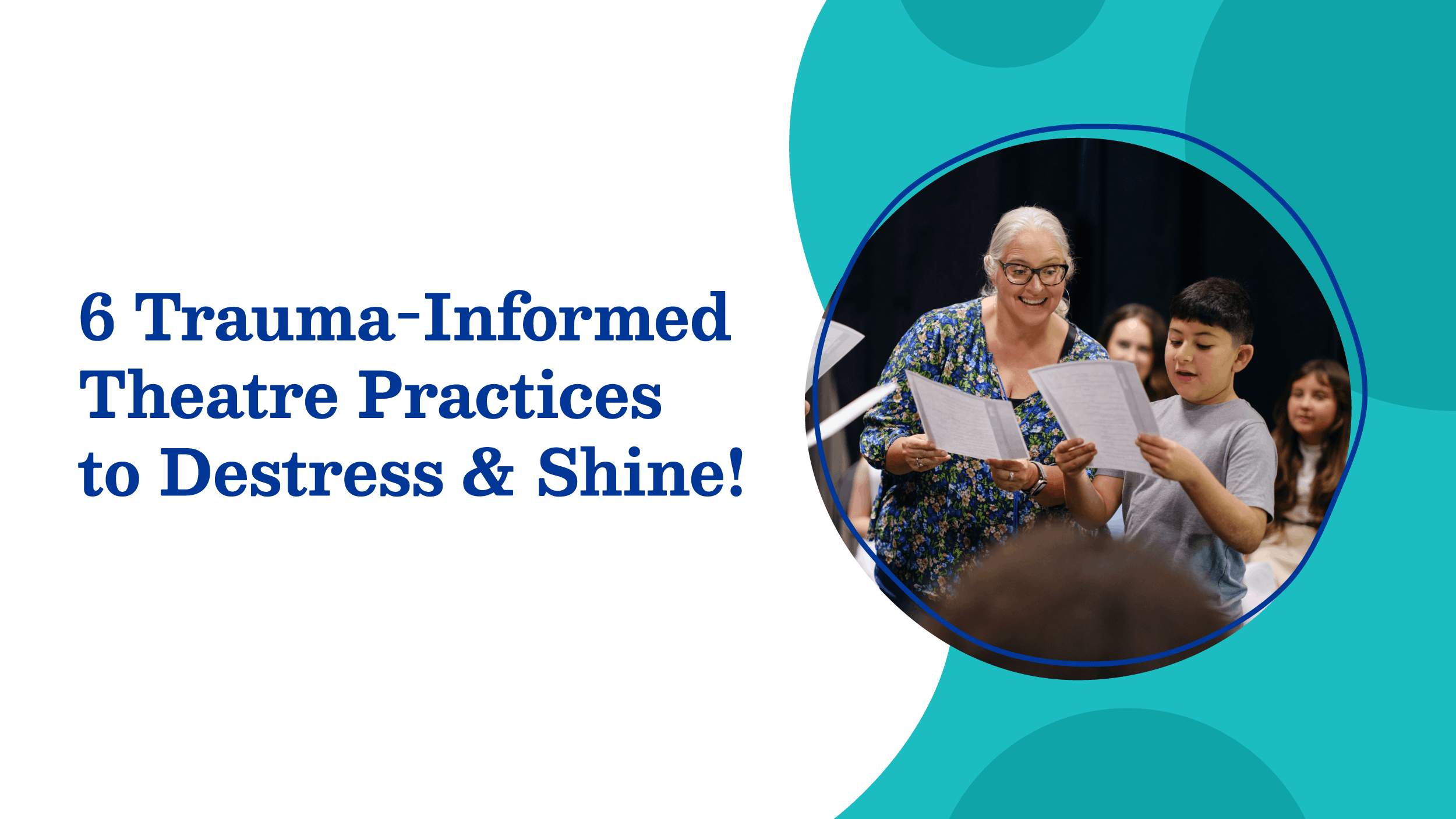
It’s Time to Shine: 6 Trauma-Informed Theatre Practices to Ease Stress
It’s Time to Shine: 6 Trauma-Informed Theatre Practices to Ease Stress
By Jennifer Wienke, Trauma-Informed Educator Fairbanks, Alaska
It’s National Stress Awareness Month, and as a trauma-informed theater educator at the Fairbanks Academy of Community Theatre (FACT) in Fairbanks, Alaska, it’s the perfect time to share strategies to help mitigate youth and family stress.
“Life-changing” is a word communicated to the FACT team often in emails, social media posts, and in the area on an audition form that asks for additional information to work better with families. These are words we deem common in our work.
But for the families we work with? It is life-changing.
Before diving into trauma-informed practices, I want to share a story of a 14-year-old student we work with. After a summer camp two years ago, we received a thank-you card signed by an entire family (mom, dad, and big brother). Their child was in our week-long camp and was a new face for us. He was a quiet student who didn’t speak to us or others, but that’s common in the theater world. Everyone needs time to settle in before their light gets to shine. What we didn’t know was that he was nonverbal and didn’t speak until well into middle school, and after, only spoke to family and close friends.
This was the moment we realized the value of our work and how it affects the people in our world.
6 Trauma-Informed Theatre Practices
Trauma-informed theater practice is the backbone of my organization in Fairbanks. We provide a safe space for all students and families, meeting everyone where they are while exploring the arts. When my partner and I began our company, we designed every facet with the mindset of what we wanted in a youth program growing up — a place that could give us a chance to explore theater and feel safe and nurtured when our homes did not provide the support we needed.
In each of our programs, we focus on developing connections, fostering a predictable environment, creating a strong sense of belonging, and building self-esteem for the youth we serve. We work extensively on confidence-building interactions, and we understand that everyone has a story. Our students, of all ages, come to us with past traumas. Our job is to create a safe space that resists retraumatization.
In my presentation, “Act It Up”: Trauma-Informed Theater Practices for Every Classroom, we walk through a typical rehearsal and explore how intentional practices can help students combat and manage stress, including:
A predictable schedule and routine to create stability
Warm welcomes to help every student feel seen and heard
Regular emotional check-ins to support self-awareness and regulation
Clear communication and choice, including opportunities to ask questions and opt out if needed
Tools for success, such as a cast website for each program, with resources to build confidence throughout the project
Thoughtful daily reflections to help students recognize their growth and take pride in their contributions
How Harmony Supports My Community
Sanford Harmony resources have been pivotal in helping our process, especially when working with our teen mentors as directors in training or camp mentors. Our mentors always have Quick Connection Cards ready in their badge holders to help campers build connections, resolve conflicts, or offer brain breaks. Since our programs all take place outside of the school day, we utilize Harmony Out-of-School Time (OST) lessons in our work, especially with our youngest cast members. Even the Harmony mascot Z has been seen perched on our light board or hanging backstage in a youth production for a quick hug if needed!
Stress and anxiety can peak at this time of year, especially with state testing approaching. Many parts of the trauma-informed approach can help families and educators by providing easy-to-implement tools with social, personal, and academic learning concepts. With a focus on belonging, clear communication, and brain breaks, stressful days can be more manageable for everyone.
A Life-Changing Transformation
It has been two years since the 14-year-old nonverbal student came to us. Since that time, he has had three leading roles and tons of ensemble roles, has become a camp mentor, and learned how to do sound and instruct small youth groups. On our most difficult days, we think of these stories, and we are inspired all over again.
Whether it’s Stress Awareness Month or any other time, always remember to power through, knowing we must continue offering tools for every person to find their “shine”.
Jennifer Wienke is the current program development coordinator for Out-of-School programming in the Fairbanks North Star Borough School District. In her time off, she is the owner and director of the trauma-informed theater company, Fairbanks Academy of Community Theater. Jennifer is a proud member of the Harmony Educator Advisory Group.
National Nutrition Month: How Food Can Nourish Belonging in Our Schools
National Nutrition Month: How Food Can Nourish Belonging in Our Schools
By Esther Deth, Ed.D
School Wellness & College Preparation Coordinator, Long Beach Unified School District
When I think about some of my fondest memories with family and friends, many of them are centered around food. From joyful gatherings like a holiday potluck to quieter, meaningful moments — such as sharing a final meal with my mother at her bedside — food has often been part of how I connect, reflect, and feel a sense of belonging. I suspect I’m not alone in this experience.
That connection came into focus for me recently through my daughter’s kindergarten classroom. Her teacher shared a series of photos with families. In one image, my daughter and her classmates sat together around a table, smiling as they peeled and enjoyed mandarin oranges. In another, the students were outside in the school garden, examining new growth that had sprouted from seeds they had planted. The teacher explained that the class had been learning about germination, watching their radish seeds grow, and then enjoying fruit donated by the cafeteria team — making a real-world connection between seeds, food, and nutrition.
When I asked my daughter about the day, her response was simple: It was “a happy day in the garden.” But as we talked more about the photos, it became clear that something deeper was happening. Through food, learning, and time together, the students were building connections. Nutrition instruction wasn’t just about healthy eating — it was helping foster a sense of belonging.
Healthy Nutrition and a Strong Sense of Belonging
A sense of belonging is foundational to student well-being, engagement, and lifelong success. According to a recent article by Allen (2022), research shows that shared food experiences can strengthen relationships and help students feel seen and valued. Food is tied to culture, community, and memory, and when schools create space for students to experience food together, they support meaningful connections.
School lunch conversations, nutrition education lessons, garden-based learning, and collaborative food activities all offer opportunities for communication, respect, and relationship-building. These moments allow students to learn about one another while practicing essential social skills in ways that feel natural and joyful.
Community Built Around Food
In my work as a School Wellness and College Preparation Coordinator for a large urban school district, I’ve seen how intentional nutrition efforts can strengthen community across grade levels. Districtwide wellness policies focused on healthy eating and physical activity help create shared language and collective responsibility for student well-being.
At school and community events, food frequently becomes a bridge between families.
When families share meals that reflect traditions, it creates opportunities for connection, storytelling, and mutual respect. These experiences reinforce that schools are communities of learners where everyone belongs.
I’ve also observed older students engaging in nutrition instruction in creative ways. In secondary classrooms, students have collaborated to plan a food court outing with friends that stays within a budget while meeting specific nutrition criteria. Activities like these allow students to explore how food choices can connect to health, personal responsibility, and real-world decision-making — while strengthening teamwork and communication skills.
Starting Conversations with Harmony Quick Connection Cards
One of the simplest ways to foster belonging is to start meaningful conversations. Harmony Quick Connection Cards offer tools that do just that. The cards invite students to share favorite meals, family traditions, or food-related memories, providing starting points for building relationships.
These quick conversations — used during Meet Ups and Buddy Ups — support a sense of belonging. They honor students’ experiences while helping educators cultivate communities of learners. My colleague, Kate Komatz, and I have trained hundreds of elementary teachers on using these cards, and we regularly hear success stories. We now encourage teachers, counselors, and school leaders to use a card as students head to lunch or to hold a class Meet Up outdoors in a school garden or shared space.
Nourishing Bodies and Communities
Food is never just fuel — its connection, culture, and care. During National Nutrition Month, schools have an opportunity to highlight how nutrition instruction can support both physical health and a strong sense of belonging.
By creating shared experiences around food, whether in a garden, a lunch conversation, or a health lesson — educators can help students feel connected and respected. When we nourish bodies and relationships together, we strengthen the foundation for lifelong success.
About Esther Deth, Ed.D
As the School Wellness & College Preparation Coordinator for Long Beach Unified School District, Esther Deth oversees curriculum and instruction for Health, Physical Education, and School Wellness, and she coordinates the district’s Advanced Placement and AVID programs. She recently co-led the districtwide implementation of the Harmony curriculum across more than 50 elementary and TK–8 schools. Dr. Deth also oversees implementation of the Local School Wellness Policy through the district’s School Wellness Council. She brings prior experience as a principal, assistant principal, and National Board–Certified teacher in Los Angeles. She is a proud member of the Harmony Educator Advisory Group.
Reference
Allen, K.-A. (2022, March 23). Psychology Today. Psychology Today. https://www.psychologytoday.com/us/blog/sense-belonging/202203/what-does-food-have-do-belonging-and-schools
Designing for Belonging: Practical Leadership Strategies That Strengthen Learning
Designing for Belonging: Practical Leadership Strategies That Strengthen Learning
By: Douglas Fisher, Ph.D., Nicholas Yoder, Ph.D., Sarah Caverly, Ph.D., Miriam Blanc-Gonnet
The desire to belong is a fundamental aspect of the human experience. Genuine belonging extends beyond simply fitting in, as it reflects being seen, accepted, and valued for who we truly are. Psychologist Geoffrey Cohen defines belonging as “the feeling that we’re part of a larger group that values, respects, and cares for us, and to which we feel we have something meaningful to contribute” (Cohen, 2022).
In schools, belonging is not a “nice to have.” Research consistently shows that a strong sense of belonging is associated with students’ academic engagement, motivation, and learning (Štremfel et al., 2024; Gülşen, 2024). When students do not feel they belong, they may question their value within the school community, which can undermine learning regardless of the quality of instruction they receive. In contrast, students who experience a sense of belonging feel supported and connected to the school community, which contributes to stronger well-being and better academic outcomes (Allen et al., 2025).
If belonging is foundational to learning, the question becomes how leaders intentionally ensure students and staff feel it at scale. This requires more than isolated initiatives; it calls for a shared language, consistent practices, and daily interactions that reinforce connection and care across classrooms and school communities — for instance, those practices found at Sanford Harmony.
The following five strategies highlight concrete, research-informed actions that school and district leaders can implement to strengthen connections and belonging across a school community:
Belonging Builder 1: Welcoming Schools, Not Just Welcoming Classrooms
A school’s climate plays a meaningful role in learning and engagement. Research shows that students are more likely to engage academically when they feel welcomed by the adults in their school environment, an effect that has been demonstrated in studies of teachers greeting students at the classroom door (Allday et al., 2011; Smith et al., 2024).
For school and district leaders, the opportunity lies in extending this practice beyond individual classrooms and into the school’s overall culture. Leaders can support this work by equipping staff with shared language and practical tools that make relationship building a visible and consistent part of the school day. For example, Harmony’s Everyday Practicesprovide consistent and predictable routines to build connections. When adults intentionally acknowledge students by name during arrival, transitions, lunch, recess, or passing periods, they reinforce the message that students are seen, that they matter, and that they belong.
Even brief, genuine interactions, such as a smile, a wave, or a few encouraging words, can have an outsized impact. These moments signal care, strengthening students’ sense of belonging, and shaping a school climate where students feel welcomed throughout the day, not just at the start of class (Jang, 2024). These practices even work with the adults in the building, including colleagues and families.
Belonging Builder 2: Foster Belonging Through Visible Contribution and Shared Responsibility
Feeling needed is a powerful driver of belonging to students, just as it is for adults. When schools create opportunities for students to take on meaningful leadership roles and responsibilities, they communicate that their contributions matter (Jang, 2024).
Shared responsibility is most effective when grounded in trust, authentic communication, and understanding what is meaningful to students. When students feel they make authentic contributions, they foster agency, engagement, and a deeper connection to the school environment (Jang, 2024). When students are invited to contribute beyond their individual classrooms, they begin to see themselves not just as learners, but as active participants in shaping school culture.
School and district leaders can support this work by designing structures that make student contributions visible and meaningful across the school. Examples include:
Cross-grade mentoring programs
Peer mediation or conflict-resolution teams
Youth-led clubs or initiatives
Student councils supporting schoolwide events
In these roles, students support peers, contribute to problem-solving, and help strengthen the sense of community. These opportunities reinforce a sense of belonging by affirming that students are not only included in the school community but also needed by it.
Belonging Builder 3: Pathways for Student Participation and Voice
A core element of belonging is the feeling that one’s voice matters. In some school settings, participation may be limited to a small group of students who are most confident, outspoken, or comfortable sharing publicly. When opportunities to contribute are optional or high-risk, some students withdraw, while others begin to doubt that their perspectives are valued.
Research on classroom participation emphasizes the importance of providing universal response opportunities, encouraging students to engage safely and simultaneously, rather than relying solely on volunteers or random selection (Marsh et al., 2023). While these strategies are often discussed at the instructional level, the underlying principle applies just as strongly to school leadership: belonging grows when participation is designed to include everyone. This principle is reflected in approaches that embed regular check-ins, reflection, and shared discussion prompts into the school experience — such as those in Harmony’s Meet Up — helping participation feel routine rather than exceptional.
School and district leaders can apply this principle by creating structures that invite broad student input and normalize participation across the school community. This may include implementing schoolwide check-ins or student surveys that provide a low-stakes opportunity for students to give feedback on their various school experiences. These practices signal to students that their voice is an expected and respected part of the school culture.
Belonging Builder 4: Collaboration That Requires Every Student’s Contribution
When students work together toward common shared goals or to achieve a group task, they build relationships, practice communication, and develop a sense of collective responsibility. Research consistently shows that structured collaboration, where students are expected to interact, contribute, and rely on one another, supports deeper learning and stronger peer connections (Fisher & Frey, 2021).
Yet not all collaboration is equally effective. When group work lacks structure and accountability, some students may disengage while others carry out the majority of the work. Productive collaboration is intentionally designed so that each student has meaningful responsibility. In these settings, students understand that their contributions matter to the group’s success.
School leaders can apply this principle by providing opportunities for productive collaboration throughout the school community. This could involve cross-class or grade-level teams collaborating on a shared product:
A school mural
A community reading or literacy project
A science exhibition
Additionally, it may involve establishing clubs organized around creating something together:
Robotics build
A Reader’s Theater production
School Yearbook
When collaboration is intentional, students recognize that they are part of something larger than themselves, and this interdependence is a powerful contributor to their sense of belonging.
Belonging Builder 5: Shift the Balance Toward Moments of Success
Students are more likely to take academic and social risks when they feel connected to their school community and believe that success is attainable. Research shows a consistent positive relationship between a student’s sense of belonging and their engagement, motivation, and participation in learning activities — all of which are foundations for risk-taking in academic contexts (Korpershoek et al., 2019).
Belonging is strengthened when students can draw on past successes to navigate new challenges. When the balance tips in favor of success, students are more likely to view setbacks as temporary rather than defining. They develop confidence in their ability to persist and grow.
At the school level, leaders can support this process by creating regular opportunities for students to experience and recognize their successes. This may include structuring schoolwide initiatives or expectations in ways that allow for early wins. For example, a student who has struggled to participate in class is recognized for increased participation, earning a shout-out on the morning announcements.
Equally important is making success visible and consistent. Schools can reinforce a sense of belonging by regularly noticing and acknowledging growth. This recognition may occur during morning announcements, classroom-to-schoolwide shout-outs, or brief interactions between staff and students throughout the day. Over time, these moments of success help students develop a history of positive experiences that they can draw upon when facing new challenges, thereby strengthening both their resilience and their sense of belonging within the school community.
From Intention to Action
Fostering a sense of belonging within a school community should not be treated as an idealistic add-on; it should be a fundamental part of the school’s culture. It is an evidence-based approach that directly influences students’ learning and well-being. When belonging is elevated as a schoolwide priority, schools not only support stronger academic outcomes but also help students develop the confidence and resilience they need to navigate challenges both in and beyond school.
The strategies outlined here offer practical, high-impact actions that can be easily embedded into the daily life of a school without incurring high costs or complexity. While none are flashy or new, their collective impact is substantial. When leaders commit to creating environments where students feel seen, valued, and needed, belonging becomes not just aspirational but a lived reality.
Reflect & Discuss
What barriers make it challenging to implement belonging builders, such as the ones listed here, in your school?
What leadership decisions could help remove those barriers?
What small, manageable steps could you take to begin introducing these strategies over time?
Fisher, D., & Frey, N. (2021). Better learning through structured teaching: A framework for the gradual release of responsibility (3rd ed.). ASCD.
Jang, S. T., & Lee, M. (2024). Exploring the link between students’ sense of school belonging and shared leadership in U.S. high schools. American Educational Research Association, 10. https://doi.org/10.1177/23328584241304699
Korpershoek, H., Canrinus, E. T., Fokkens-Bruinsma, M., & de Boer, H. (2019). The relationships between school belonging and students’ motivational, social-emotional, behavioural, and academic outcomes in secondary education: a meta-analytic review. Research Papers in Education, 35(6), 641–680. https://doi.org/10.1080/02671522.2019.1615116
Štremfel, U., Ivančič,, K. Š., & Peras, I. (2024). Addressing the sense of school belonging among all students? A systematic literature review. European Journal of Investigation in Health, Psychology and Education, 14(11), 2901–2917. https://doi.org/10.3390/ejihpe14110190 Gülşen, F. U. (2024). The effect of a sense of school belonging on academic achievement: A meta-analytical review. e-Kafkas Journal of Educational Research, 11(4), 673– 687. https://doi.org/10.30900/kafkasegt.1359812
“One must nurture the joy in one’s life so that it reaches full bloom.” – Maya Angelou
Many of us approach a new year by “resetting” goals and expectations in our classrooms and homes, using the calendar to instigate a fresh start or commit to resolutions. But what if we used the promise of the new year to intentionally cultivate joy for ourselves and our students? Most of us would welcome more joy in our lives in these times of uncertainty and conflict and it’s possible to design our classroom experiences with joy in mind.
Joy as a Way of Being
While joy is often thought of as fleeting and brought on by external circumstances, in The Book of Joy: Lasting Happiness in a Changing World, Archbishop Desmond Tutu and the Dalai Lama posit that joy is a state of mind and heart — a way of being that doesn’t deny challenges and difficulties but rather embraces compassion and acknowledges our connectedness. Research provides multiple definitions of joy, with University of Cambridge scholar, Matthew Kuan Johnson, offering this helpful interpretation: “joy involves a state of positive affect, in which one experiences feelings of freedom, safety, and ease” (2019, p.6).
Joy facilitates our goals as educators, helping effective learning and development to take place.
Johnson cites research that joy provides children with,“the opportunity to learn new cognitive and behavioral skills and forge new social relationships and skills, which enhances resilience to future obstacles . . .” (2019, p. 6). In further support for creating joyful classroom environments, experiences that spark relational joy — moments shared by educators and their students — help to build connection and collective well-being (Karjalainen, et al., 2019).
Creating Joy-Nurturing Conditions
However we choose to define it, we can invite joy into our learning spaces by modeling a joyful state of mind and creating what I like to call joy-nurturing conditions.
It’s easy to be intimidated by the task given the challenges we and our students experience every day. But inviting joy does not need to be elaborate. It can be as simple as asking students what makes them feel free, safe, and at ease and working to incorporate their responses into your routines. In my own homeschool classroom, my children and I focus on micro-moments of joy, like having an impromptu dance party to celebrate even the tiniest win or taking a break to have ”poetry tea time” where they choose the poems we read. Below, you’ll find examples of the ways the Harmony Educator Advisory Group create joy-nurturing conditions and design for joy in their own classrooms . . .
We invite you to hear the classroom joy from across the nation!
“It’s easy to find joy in an elementary classroom. Many classrooms feel like a family — a place where students experience a true sense of belonging, feeling accepted, included, and safe. This supportive environment sets the stage for students to take risks and form meaningful connections to their learning. Joy is often seen and heard in those powerful moments when a student makes a breakthrough or when something they’ve been working hard on finally clicks. In those moments, learning feels like fireworks!”– Randi Peterson, Elementary Curriculum Developer, Bellevue School District
“I have seen the most joy from my students when they are collaborating and connecting with one another. It brings me true joy to listen and watch my students have genuine discussions during our turn and talks, and the excitement that they show while sharing with their classmates during our morning meeting. In our classroom we celebrate one another’s accomplishments, cheer one another on, and are each other’s biggest supporters.” – Aimee Gallant, 1st Grade Teacher, Hopewell City Public Schools
“The purest joy in my classroom isn’t seeing an A+; it’s watching the immediate, practical success of the Harmony Curriculum. It’s the collective sound of children truly connecting. There is nothing better than watching students execute the ‘Team Manuel Handshake’ during morning Meet Up, taking turns listening without interruption, and genuinely leaning in for the discussion cards. When the music starts, they eagerly find their partners for the movement activity — that is the sound ofempathy coming to life, laughing and sharing together. Their smiles are the sound of pure joy that makes teaching truly come alive.” – Anderson Manuel, 1st Grade Teacher, Sudbury Public Schools
“Each school year, building a nurturing classroom community sparks joy. A safe and caring learning environment is essential if we want our students to thrive. Relationship-building takes time and practice. As educators, when we provide students with opportunities to interact with each other, they develop positive attitudes and healthy relationships—fostering empathy, understanding, and caring.” – Sharyn Kang, 3rdGrade Teacher, Chula Vista Elementary School District
“In my classroom, JOY is everywhere! When I think of joy in my students and the community we’ve built, I think of affirmations. Our Harmony Class Goals (our class promises) are written as affirmation statements. We have an Affirmation Station, which is a mirror in the corner with affirmations around it for students to say to themselves, like “I am creative!” and “I am brave!”, and every single morning, we start the day together with an affirmation song. This not only sets the tone for the day, but for the entire school year! Affirmations lead to self-love, confidence, compassion, and support for each other. We celebrate what makes us unique and build upon those strengths!” – Josie McClain, 2nd grade teacher, Paloma Elementary School District
Works Cited
Dalai Lama, & Tutu, D. (2016). The book of joy: Lasting happiness in a changing world. (D. Abrams, Ed.). Avery.
Johnson, M. K. (2019). Joy: a review of the literature and suggestions for future directions. The Journal of Positive Psychology, 15(1), 5–24. https://doi.org/10.1080/17439760.2019.1685581
Karjalainen, S., Hanhimäki, E., & Puroila, A. M. (2019). Dialogues of joy: Shared moments of joy between teachers and children in early childhood education settings. International Journal of Early Childhood, 51(2), 129–143. https://doi.org/10.1007/s13158-019-00244-5